
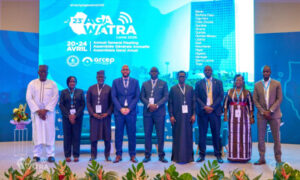
(Togo First) – Ahead of the opening ceremony of the 23rd Annual General Meeting of the Association of Telecommunications Regulators of West Africa (ARTAO), scheduled for Wednesday, April 22, 2026, in Lomé, the Togolese capital, roundtables were held 48 hours earlier at the Hôtel 2 Février. Discussions focused on several key themes, including strengthening public-private partnerships to finance broadband infrastructure and accelerate connectivity in Africa, with a focus on models capable of supporting the expansion of digital technology across the continent. It should be noted that ARCEP-Togo, the host of this event, was represented by its top manager, Yaovi Galley.
In Africa, the expansion of broadband remains hampered by the challenge of infrastructure financing. During a roundtable discussion on “models for accelerating broadband expansion,” panelists reached a conclusion: a funding gap leads to an infrastructure gap, hindering digital development.
An infrastructure gap that slows digital development
Today, only 29% of the population of sub-Saharan Africa has access to the internet, according to the GSMA (2023). At the same time, 40 to 50% of rural areas remain without reliable network coverage. This gap not only limits access to information but also hinders the development of essential services such as e-education, telemedicine, and digital financial services.
The cause is particularly heavy investment. Deploying fiber optic cable, for example, costs between $10,000 and $30,000 per kilometer, depending on the topography and population density of the areas. Also, the costs associated with submarine cables, base stations, and recent technologies like 5G.
Persistent economic and geographical constraints
Beyond cost, operators face significant geographical inequalities. Rural areas, often remote and unprofitable, attract little interest due to uncertain returns on investment. Hence the need to diversify funding sources.
To address these challenges, several funding sources exist: first, the public sector through national budgets, targeted subsidies, sovereign wealth funds, and universal access funds to cover unprofitable areas. The private sector intervenes through direct operator investments, capital contributions (particularly in data centers); there are also BOT (Build-Operate-Transfer) models, joint ventures, etc.
Donors, generally multilateral financing institutions such as the World Bank, the African Development Bank, the French Development Agency, and the International Finance Corporation, are playing their part, notably through loans, guarantees, and technical support.
Innovative mechanisms are also emerging and should serve as models, such as green telecommunications, the use of renewable energies, and community-based crowdfunding for projects with a strong social impact, it was noted.
The public-private model is gaining ground
According to the participants, the most effective model remains the one that combines the strengths of the public and private sectors. In this approach, the private sector provides the bulk of the investment, innovation, and technical implementation, while the government intervenes in a targeted manner to support unprofitable areas, reduce financing risks for the private sector, and create an incentive framework.
Public-private partnerships (PPPs) thus appear as a strategic lever, allowing for risk sharing, cost optimization, and accelerated deployment times.
Beyond public-private partnerships (PPPs), the focus has been on pooling resources and sharing infrastructure, enabling operators to reduce their costs while expanding coverage, particularly in densely populated areas that are less competitive for large-scale investments.
*** Towards a Coordinated Approach in West Africa
At the regional level, the challenges call for increased coordination between states, particularly for the deployment of submarine cables and the harmonization of regulatory frameworks under the auspices of organizations such as the Association of Telecommunications Regulators of West Africa (ARTAO). The objective is clear: to achieve universal connectivity by 2030, by mobilizing all stakeholders: states, the private sector, and technical and financial partners.
Recommendations have been formulated to accelerate broadband deployment. These include establishing a harmonized and incentive-based regulatory framework; promoting innovative financing mechanisms adapted to local realities; increasing the use of public-private partnerships (PPPs); supporting research and training in electronic communications; and improving project governance and transparency. All of this must be done while maintaining the crucial role of regulators in ensuring strong regulation to guarantee efficiency, inclusion, and sustainability.
S.A.
.